Business / AI-assisted brief
GRAIS puts an AI co-pilot inside everyday chats — and a Maltese investor sees an opportunity
The early-stage European Chrome extension drafts context-aware replies across five major chat platforms, while an anonymous Maltese investor argues that attracting companies like it could deepen Malta's AI economy.
By Malta News AI Desk / 25/08/2026
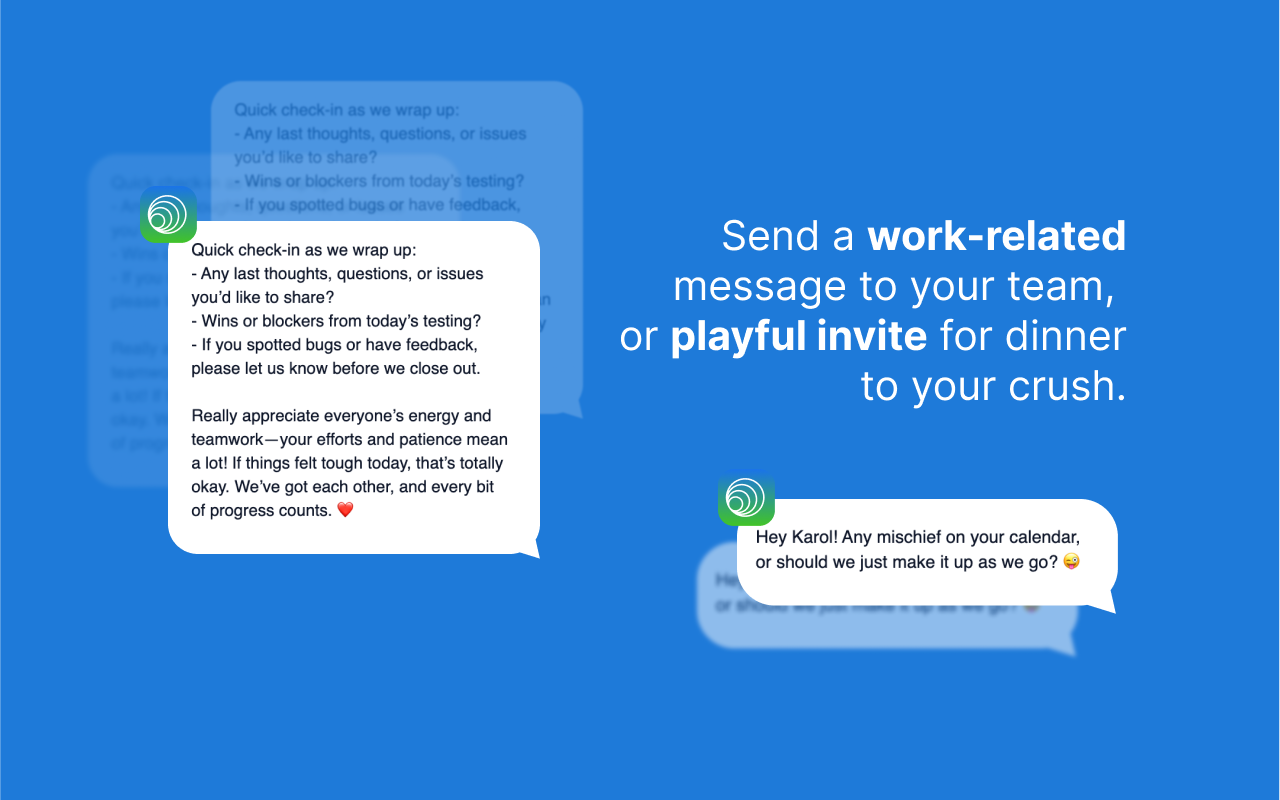
A European artificial-intelligence product is trying to move the AI assistant out of a separate chatbot window and into the conversations where work and relationships already happen. GRAIS, a Chrome extension described by its maker as an agentic communication assistant, places a sidebar beside supported web chats and proposes replies using the thread's context, the user's preferred style and a stated objective.
That is the product which has caught the attention of a Maltese investor who asked not to be named. He says he is contacting founders across Europe and trying to persuade selected technology businesses to establish a presence in Malta. GRAIS is one of the companies he believes could have very large international potential, possibly reaching billion-dollar scale if the product, team and market develop as he hopes.
There is no announced investment, partnership or relocation agreement between GRAIS and the investor, and Malta News has not independently confirmed that the company's founders are considering Malta. His interest is best understood as an early approach and a wider argument: Malta should compete for promising AI companies before they become obvious global winners, rather than waiting until they are too large and expensive to attract.
What the extension actually does
GRAIS currently lists integrations with WhatsApp, Telegram, Instagram, LinkedIn and Tinder. Instead of asking a user to copy a message into a general-purpose AI tool, compose a prompt and paste the answer back, the extension is designed to read the supported conversation context and stream a proposed response in a sidebar. The user remains in the original chat interface and controls what is inserted or sent.
The important distinction is context. According to the product listing, GRAIS can keep long threads coherent, build style profiles that adapt to a user's voice and work towards configurable goals such as closing a sale, clarifying an issue or de-escalating a tense exchange. The company's website also says the assistant can surface promises made by either party, summarise intent and subtext, and preserve tone across more than 30 languages.
For a salesperson, that could mean a follow-up which remembers the prospect's objection and aims for a concrete next step. For a support worker, it could mean a calmer answer that takes account of earlier troubleshooting. For a recruiter or networker, it could mean retaining the relationship history without manually rebuilding the background every time. The same machinery also extends into personal conversations, which is why the product markets itself beyond business use.
GRAIS also advertises optional Model Context Protocol, or MCP, connections. MCP is a way for an AI assistant to connect to approved tools and information sources. In practical terms, a company could potentially let the assistant consult product information, internal knowledge or a defined process before drafting an answer. That is more ambitious than autocomplete: it points towards an agent that can combine a live conversation with company-specific facts and an intended outcome.
The developer describes an ‘autonomy ladder’ ranging from reviewing every draft, through voice approval, to automatic responses for known conversations. Those levels matter because fluent text is not the same as sound judgement. A wrong price, an invented policy or an overconfident promise can create a real commercial liability. Keeping a human approval step is likely to be the sensible setting for regulated, sensitive or high-value exchanges, whatever greater automation becomes available.
Why the idea is compelling — and what still needs proving
GRAIS is attractive because communication overload is a real cost. Teams spend time recovering context, changing tone for different audiences and deciding how to move a thread forward. An assistant which works across channels, remembers useful details and reduces tool-switching could turn that repetitive effort into a faster review task. The cross-platform approach is also a stronger proposition than a helper tied to only one inbox.
But this is still an early-stage product, not a proven category leader. On 25 August, its Chrome Web Store page showed 64 users, a five-star score based on a single rating, and version 0.2.125, updated on 20 August 2026. The listing identifies the developer as Poland-based REPLYPILOT SP ZOO. Those numbers do not undermine the concept, but they are too small to demonstrate mass adoption, retention or a durable business model.
Privacy will be central to whether the concept succeeds. The Chrome Web Store says the developer declares that user data is not collected or used and links to its privacy policy. The company says users can choose trust levels for actions. Even so, any tool that uses conversation history may encounter commercially sensitive or deeply personal information. Prospective users and corporate buyers should inspect the permissions, data-handling terms, retention rules and controls that apply to their chosen features rather than relying on an AI label or a store rating.
What Malta could gain
The anonymous investor's thesis is that a pipeline of European AI founders could do more for Malta than produce a few company registrations. If businesses place product, engineering, research, compliance and commercial teams on the island, they create skilled jobs, train local staff and generate demand for lawyers, cloud specialists, security professionals, accountants and universities. Successful founders and employees can later become mentors, angel investors and customers for the next local company.
A communication product also fits parts of Malta's existing economy. The country hosts multilingual customer-service operations, financial services, online gaming, tourism businesses and internationally focused small companies. All depend heavily on fast, careful communication across languages and time zones. That creates a possible test market for responsible AI-assisted support, sales and account management — provided sector rules, data protection and human oversight are respected.
Attracting such companies would also force useful investment in the less glamorous foundations of AI: reliable power, resilient connectivity, secure cloud architecture, data governance, cybersecurity and access to computing capacity. Malta does not need every startup to build a data centre on the island. It does need the engineering knowledge, procurement capability and regulatory confidence to run AI services reliably from Malta and sell them abroad.
There are constraints. Skilled technical workers are scarce, housing and wage pressures affect recruitment, and AI infrastructure can add power and cooling demand. Incentives alone will not create a cluster. The stronger offer would combine predictable regulation, research links, specialist visas where needed, local training, access to capital and practical help for founders establishing real operating teams rather than nominal offices.
The investor says he is approaching multiple founders because even a small success rate could matter. That is plausible as a portfolio strategy, but the billion-dollar language remains an aspiration. The immediate test for GRAIS is simpler: can it earn users' trust, demonstrate that its memory and tone controls improve outcomes, and convert a clever extension into a product people and businesses will pay to use repeatedly?
GRAIS offers a concrete glimpse of where applied AI may be heading: less time spent talking to a blank chatbot, and more assistance embedded inside existing work. Malta's opportunity is not to endorse every promising app. It is to become a place where credible teams can build, test and govern products like this — and where the economic value includes local people, infrastructure and knowledge when they succeed.
Read the official source: GRAIS Chrome Web Store listing
How this story was reported
Source
This brief is limited to the named source linked above. Readers can use that link to check the original announcement or record.
Method
AI may assist with drafting source-attributed briefs. It may not add interviews, eyewitness details or background that the source does not support. Sensitive stories require review before publication.
Corrections
Report a material error to corrections@maltanews.com and review the corrections policy.